

The Book Sparking a Classroom Revolution: An Examined Glance at Screens 📚🔍
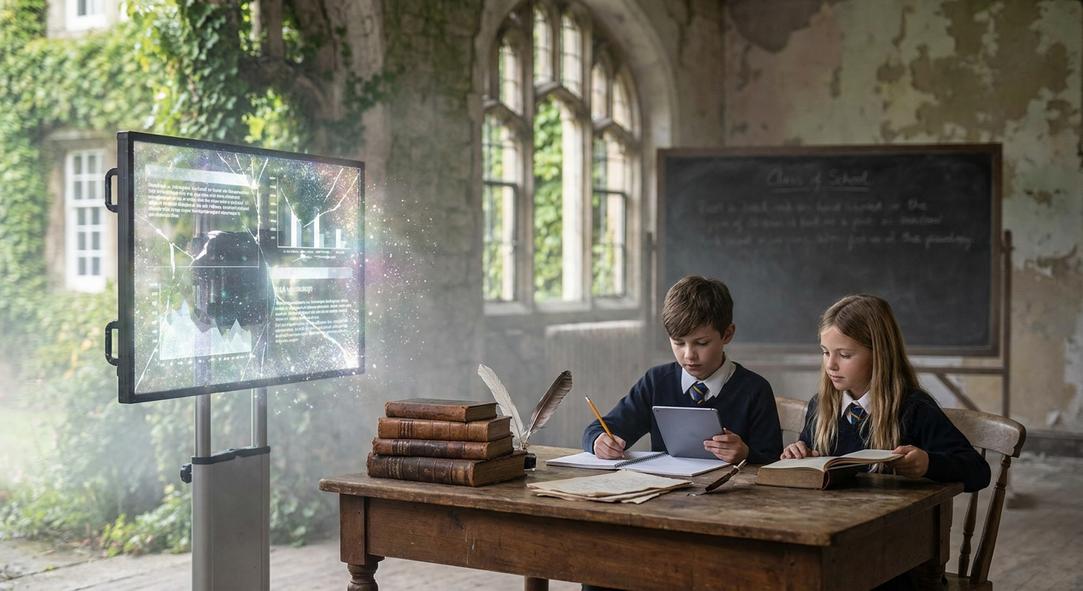
Once hailed as the panacea for educational woes, screens have embedded themselves in schools like ivy on ancient stone walls. Yet, as ivy dries and crumbles under the weight of its presumption, so too does the promise of a digital utopia in education face a challenging rebuttal. A provocative new book questions this narrative, urging a return to the roots of learning—a metaphorical pruning, if you will, to let the sunlight of critical thought filter through 💻🌞.
The Battle of Ideas: Screens versus Human Connection
At the heart of the debate lies a striking antithesis: the seductive glow of information at one’s fingertips versus the tactile richness of page and pen. But are these not paradoxical allies in the broad endeavor of education, one might ponder? Or does their coexistence only sow discord in the minds of students expected to navigate the chasm?
According to a 2018 Pearson report, 74% of teachers believed that technology positively impacts student engagement. However, a mere 28% felt it improved critical thinking—a stark juxtaposition illustrating the complexity of digital integration in education.
While Screens Reign, Real Consequences Reside 👀
Though embraced with an almost religious fervor, the belief that screens enhance learning falters upon inspection. Are students, the very focal point of this silicon salvation, truly reaping its promised benefits?
- Increased screen time has been linked with declines in attention spans, evoking the scattershot nature of a magpie’s hoard.
- Student interaction has diminished, akin to a lighthouse whose beam is lost in a digital fog.
- Mental health concerns have spiked in correlation with excessive digital consumption, paralleling waves crashing against unyielding cliffs.
A Historical Echo: The Chalkboard and the “Smart” Screen
The introduction of the chalkboard in classrooms once sparked similar controversy as screens do now. Critics worried it might displace traditional methods. However, whereas the chalkboard lived harmoniously alongside books, screens seem to seek dominion. Could it be that, like an overeager apprentice, screens must first learn? Or is this a tale of a technology miscast in the role only human educators can best fulfill?
Striking a balance between digital fluency and classical study ⚖️
Forging a peaceful alliance between technology and traditional pedagogy demands more than mere advocacy; it necessitates understanding when and how to blend these disparate elements. Like a symphony, the strengths of each must complement rather than compete.
- Critical Thinking: Encourage problem-solving that leverages both books and digital resources.
- Hybrid Classrooms: Offer spaces where screens are tools but not masters of the curriculum.
- Digital Literacy: Equip students to navigate the digital landscape while fostering an appreciation for the tactile.
A 2021 study by the Stanford Graduate School of Education found that students who mix digital and traditional learning methods outperform those who rely solely on either platform.
Conclusion: Beyond the Screen—a Reverberation of Purpose
Thus, as this literary call to arms challenges us to rethink our dependency on screens, it simultaneously invites educators to be sculptors of a modernity where technology and tradition converge harmoniously 🧠📖. The echoes of this revolution remind us that learning, in its purest form, is much like the patterned speech of a child; unpredictable, raw, and infinitely valuable.
While screens have their place, the quest for balanced enlightenment demands more than digital luminosity; it requires a return to mindful education—a garden where screens are but one blossom among many 🌷🌿.