
New Jersey Governor Challenges Protest Narrative 📢
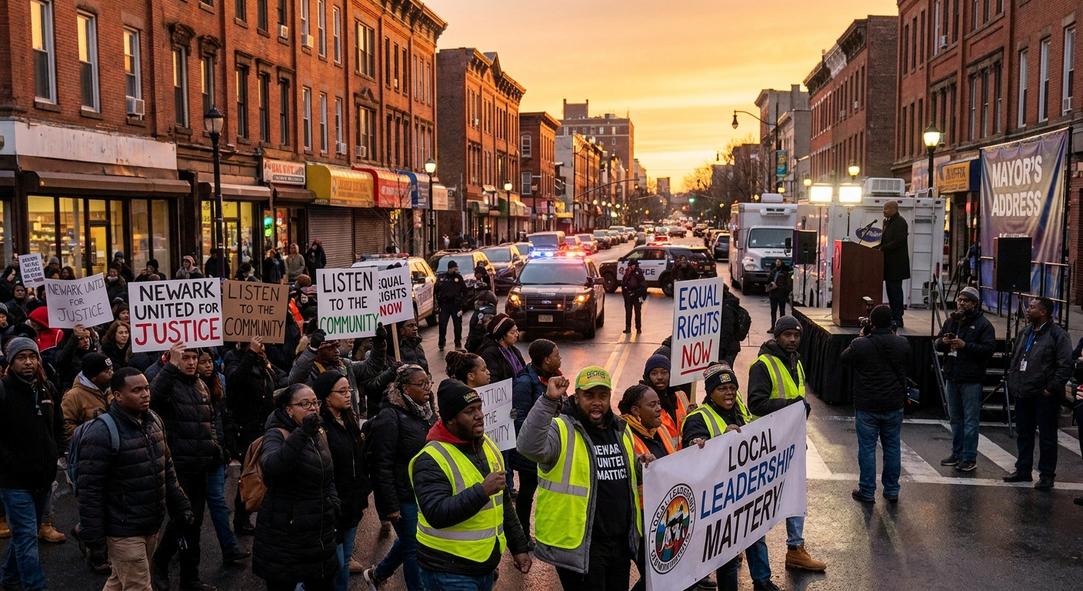
As the sun dipped below the horizon on a recent evening in Newark, NJ, echoes of protest resounded through its streets, reverberating off the facades of century-old brownstones like an undying chorus of civil unrest. Amidst the clamor, a peculiar proclamation emerged from the state’s leadership: out-of-state agitators, not local discontent, were fanning the flames of protest against ICE detention centers.
This assertion starkly juxtaposes the idyllic image of the diverse Garden State cherishing justice and inclusion. It paints a paradox where external forces, rather than local grievances, are accused of sowing chaos—a theatrical scene reminiscent of Shakespeare, where outsiders are blamed for the tragedy unraveling on home soil.
The Governor’s Accusation ⚖️
In a press conference, New Jersey’s governor declared that the fervor was stirred by individuals who crossed state lines with malice aforethought. This assertion posits a striking antithesis between homegrown activism, perceived as organic and pure, and external disruptions, likened to invasive weeds in a carefully tended garden.
The protests, a response to the incongruous landscapes of immigration enforcement and human rights, were reportedly attended by residents ardently opposing the notion that their domestic haven might harbor an oppressive mechanism.
Did you know? Historical patterns show that the blame on external agitators has often been a strategy to shift focus from localized discontent. This parallel to the domino theory of the Cold War insinuates that if one state falls to unrest, others might follow, driven by external contagion.
A Historical Echo
History, vast as the ocean and capricious as its waves, presents examples where “outsiders” have been the scapegoats for unrest. From distant eras of witch hunts to the more proximate upheavals of the civil rights movement, the narrative of “the outsider” has served as a convenient foil.
As a New Jersey native adjusts their rearview mirror and looks back at the state they call home, they might feel an ironical tinge—once it was the state of renowned hospitality, now scrutinizing its visitors with suspicion.
Local Voices and External Narratives
Meanwhile, on Newark’s street corners, conversations resemble a cacophony of an impromptu jazz session, each voice an instrument contributing to a complex harmony. Many local activists rebuff the governor’s narrative, emphasizing their community-driven resolve as steadfast as the ancient sequoias that stand tall irrespective of the breeze’s direction.
Yet, the governor’s insistence seems as immovable as the limestone Palisades, suggesting that the narrative itself may be wielding more impact than those it accuses.
Conclusion: An Uncertain Diaspora
In the arena of public opinion, where irony and imagery coalesce into a potent brew, the governor’s pronouncements serve as a reminder that narrative is king. As Newark’s residents continue their vigil, the debate over the nature of dissent grips wider audiences. They ponder whether their story will be a testament to resolve or a drama with outsiders forever cast as antagonists. In this linguistic ballet, the truth may be ever-elusive, leaving New Jersey’s narrative as open to interpretation as a poem.